
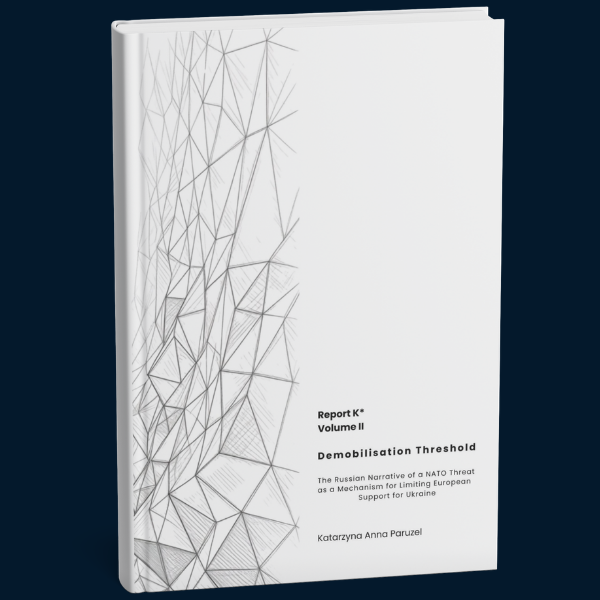
Report K*. Special Volume II – Demobilisation Threshold The Russian Narrative of a NATO Threat as a Mechanism for Limiting European Support for Ukraine (Kopia)
2400,00 zł
Is the greatest threat to Europe today a Russian attack on NATO itself, or the narrative of such an attack, which may limit European support for Ukraine? Report K*. Special Volume II analyses the threshold of strategic demobilisation and shows when fear begins to change decisions.
An expert analytical monograph devoted to the Russian narrative of the NATO threat as an instrument of influence on European decisions concerning Ukraine. The report does not primarily ask whether Russia will attack the Suwałki Gap, but whether the very narrative of a possible attack is already shifting Europe from active support for Ukraine toward defensive demobilisation.
Opis
Report K*. Special Volume II – Demobilisation Threshold
Russian Narrative of the NATO Threat as a Mechanism for Limiting European Support for Ukraine
Report K*. Special Volume II — Demobilisation Threshold is an analytical monograph of the Sir Roger Penrose Institute for Interdisciplinary Sciences devoted to one of the most important problems of European security: the influence of the Russian narrative of a NATO threat on the decisions of European states concerning continued support for Ukraine.
The point of departure of the report is the thesis that the scenario of a direct Russian attack on NATO, including in particular the Suwałki Gap, may currently have lower operational coherence than narrative coherence. This means that its greatest effectiveness does not necessarily lie in the real preparation of an attack, but in generating fear that shifts public and political debate from the question of stopping Russia in Ukraine to the question of defending one’s own territory.
The report proposes an operational model of the K* threshold of security coherence, in which narrative-strategic tension is compared with the coherence potential of the European security system. The model makes it possible to distinguish media-attractive scenarios from strategically coherent scenarios and to identify the moment when support for Ukraine begins to be presented not as a forward form of Europe’s defence, but as a depletion of one’s own defence resources.
At the centre of the analysis is the mechanism of “demobilisation through self-preservation”. It does not mean the formal abandonment of Ukraine or an explicit change in allied policy. It denotes a more subtle process: states continue to declare support, but begin to delay decisions, limit real action, condition assistance on the state of their own stockpiles, and avoid steps presented as escalatory.
The volume includes an operational model, a definition of the K* threshold, an analysis of the Suwałki Gap as a narrative weapon, a description of the demobilisation mechanism, scenarios of possible developments, a preliminary assessment of scenario probabilities, an early-warning matrix, and monitoring recommendations for public administration.
The publication is intended for individuals and institutions interested in strategic security, European policy, information warfare, state decision-making resilience, narrative analysis, and the long-term consequences of the Russian-Ukrainian war for Europe.
The report is intended primarily for:
– public administration,
– security analysts,
– experts on Central and Eastern Europe,
– academic and research institutions,
– think tanks,
– specialist journalists,
– strategic advisers,
– institutions monitoring hybrid and information threats,
– professionals working on defence policy, strategic communication, and state resilience.
The volume includes:
– an analysis of the Russian narrative of the NATO threat as a mechanism of influence on European decisions,
– a distinction between operational threat and narrative threat,
– the K* threshold model of security coherence,
– an analysis of the Suwałki Gap as a narrative weapon,
– a description of the mechanism of demobilisation through self-preservation,
– an assessment of Russian strategic rationality,
– warning signals of crossing the K* threshold,
– scenarios of possible developments,
– a preliminary assessment of scenario probabilities,
– monitoring recommendations for public administration,
– strategic recommendations,
– bibliography and data sources.
The most important value of the report lies in reversing the standard analytical frame. Instead of asking only whether Russia will attack NATO, the report asks whether fear of such an attack is already changing European decisions toward Ukraine. This shift makes it possible to analyse the threat not only as a possible military operation, but also as an instrument of political, psychological, and resource demobilisation.
The price applies to a single copy under a one-person licence and includes shipping by registered mail.
ISBN: 978-83-981584-1-1
Number of pages: 74
Cover: pdf
More details are available here