
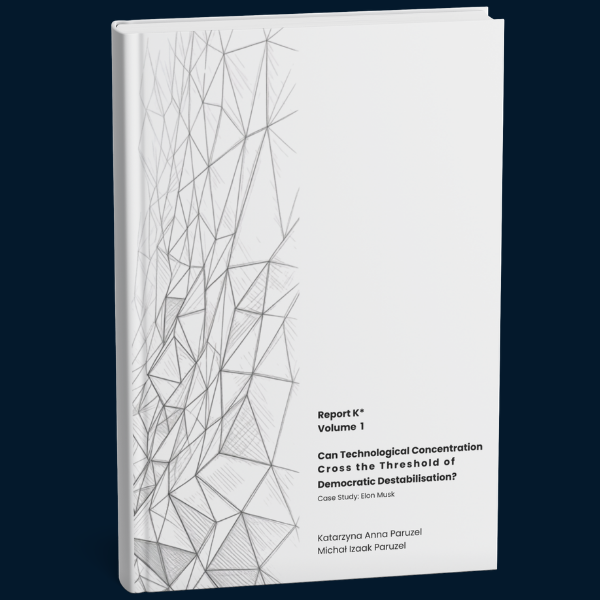
Can Technological Concentration Cross the Threshold of Democratic Destabilisation? Case Study: Elon Musk
0,00 zł
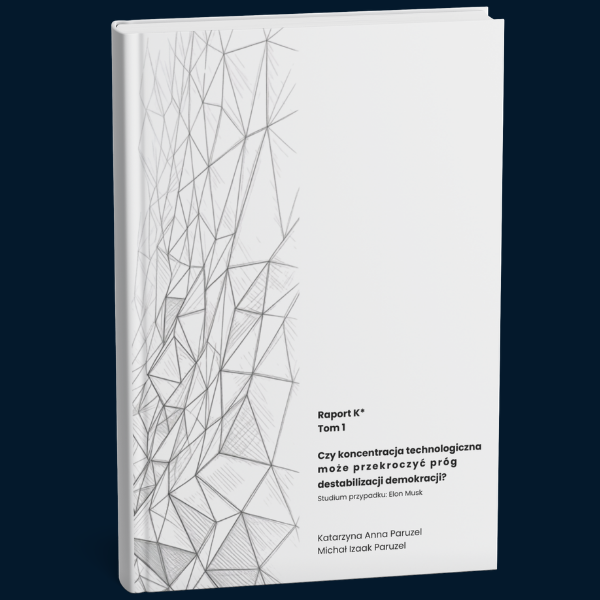
Volume 1 of Report K* analyses whether private concentration of technology, communication infrastructure, artificial intelligence, narrative capital and strategic digital resources may bring a democratic system closer to a threshold of destabilisation. The Elon Musk case is not treated as a biography or as an assessment of one individual, but as an example of a broader process: the rise of private technological power and a test of democratic institutional resilience.
The volume is made available free of charge as a demonstrative publication showing how analysis is conducted within the K* model developed by the Sir Roger Penrose Institute for Interdisciplinary Sciences.
Pages: 50
Format: .pdf
ISBN:978-83-981584-7-3
Access: free of charge
Opis
Report K* — Volume 1
Can Technological Concentration Cross the Threshold of Democratic Destabilisation?
Case Study: Elon Musk
This is not a report about Elon Musk.
It is a report about whether democracy remains resilient when private technological power begins to combine communication infrastructure, artificial intelligence, space capital, data processing and global narrative influence.
Volume 1 of Report K* presents a systemic analysis of technological concentration as one of the key challenges facing contemporary democracies. The publication is not a biography, a political commentary or a simple answer to the question of whether one individual can “destroy democracy”. Its purpose is to examine a deeper process: whether the concentration of technological, communicational and narrative resources in the hands of a private actor may exceed the democratic system’s capacity to absorb tension.
The Elon Musk case serves as the starting point for a broader analysis. In the report, Musk is not treated as an isolated exception, but as an example of a new type of concentration: one that does not concern media, capital or technology alone, but combines a platform of political communication, space infrastructure, AI systems, data-processing projects, symbolic influence and the ability to initiate global narratives.
Why is this volume free?
Volume 1 is made available free of charge as a demonstrative publication of the Report K* series. Its purpose is to show how analysis is conducted within the K* model developed by the Sir Roger Penrose Institute for Interdisciplinary Sciences.
It is therefore not a “free ebook” in the conventional sense. It is a reference volume that allows readers to see the difference between a standard analytical approach derived mainly from the social sciences and the systemic approach used in Report K*: an approach based on the relation between systemic tension, stabilising potential, coherence threshold, feedback loops, informational entropy and possible regime transition.
Why is this report different?
Most debates on technology and democracy focus on personal or journalistic questions:
Does Elon Musk have too much power?
Does platform X influence politics?
Will AI threaten democracy?
Are private technology companies becoming stronger than states?
Report K* moves the question to a deeper level:
Does technological concentration create a tension that democracy may no longer be able to compensate for?
Are corrective mechanisms — regulation, competition, informational pluralism and institutional independence — still functioning?
Can private communication infrastructure become part of a structural change in the democratic regime?
Can the combination of AI, data, platforms and narrative create a positive feedback loop between information control, political influence and institutional rule change?
Are we observing only increased volatility, or an approach toward a destabilisation threshold?
The report does not compete with daily technological or political commentary. Its value lies in identifying the structure of the process: how private technological concentration may increase systemic tension, test institutional resilience and move democracy toward a new regime of functioning.
What does the volume contain?
Methodological note
A short introduction to the K* model as a tool for analysing critical thresholds, systemic tension, stabilising potential and transitions between stability regimes.
Executive summary
A concise presentation of the central thesis: current technological concentration increases systemic volatility and tests democratic resilience, but does not yet mean that the destabilisation threshold has been crossed.
Main report: technological concentration and democracy
The central part of the volume analyses the Elon Musk case as an example of multidimensional concentration of influence. It covers communication infrastructure, strategic infrastructure, artificial intelligence, data processing and narrative capital.
Operational definition of the K* destabilisation threshold
This section explains that a system crosses the destabilisation threshold not when a powerful individual appears, but when corrective mechanisms cease to function: institutional, regulatory, informational and competitive.
Four dimensions of technological concentration
The analysis covers platform X as an infrastructure of political communication, SpaceX and Starlink as strategic infrastructure, AI and data-processing projects, and global symbolic-narrative capital.
Stabilising mechanisms of the democratic system
The report compares technological concentration with four stabilising mechanisms: legal regulation, market competition, informational pluralism and institutional independence.
Quantitative risk model
The volume presents a working model comparing destabilising tension with stabilising potential. The model is not intended as a mechanical prediction of the future, but as a diagnostic tool for locating the system in relation to the K* threshold.
Dynamic scenario analysis
The report identifies the conditions under which destabilisation risk could increase significantly: integration of communication infrastructure with AI, weakening of regulation, erosion of competition and closure of a positive feedback loop.
Informational entropy and democratic stability
A separate part of the volume analyses democracy as a system of information flow. Democratic stability requires not the absence of entropy, but a controlled level of entropy: too little entropy means informational monopoly, while too much means narrative chaos.
Feedback loops and conditions of phase transition
The report describes the risk of a loop in which information control influences politics, politics influences regulation, and regulation reinforces further control of information.
Historical comparisons
The volume relates contemporary technological concentration to earlier cases of media and political concentration, including William Randolph Hearst, Rupert Murdoch and Silvio Berlusconi.
Quantitative forecasts: 2028–2040 horizon
The publication includes forecasts concerning possible AI regulation, the future role of platform X in political communication, and the role of private technology companies in functions traditionally belonging to the state.
Weak signals
This section identifies early symptoms of a possible shift toward greater systemic vulnerability to technological and narrative concentration.
Systemic conclusion
The main conclusion of the volume is that current technological concentration around private actors increases systemic tension, raises informational volatility and creates new vectors of influence, but does not yet mean that the democratic destabilisation threshold has been crossed. The system remains in an adaptive regime, but requires monitoring.
Who is this report for?
The report is intended for:
readers interested in the future of democracy, political analysts, people working on technology and AI regulation, public administration, think tanks, media organisations, strategic communication experts, researchers of complex systems, readers interested in the influence of digital platforms on politics, and anyone who wants to understand how the K* model works in practice.
The publication may be particularly useful for readers who want to see how the systemic analysis of Report K* differs from conventional socio-political analysis. The volume shows not only the subject, but also the method: the transition from a visible phenomenon to the hidden structure of tensions, stabilisers, feedback loops and possible regime transitions.
Format and access
The volume is published in English.
It is available as an electronic PDF.
The electronic version preserves the typographic layout of the publication, including tables, formulas, figures, footnotes, bibliography and document structure.
Volume 1 is made available free of charge as a demonstrative publication of the Report K* series.
Note on the Printed Version
Volume 1 of the Report K* series is made available free of charge in electronic PDF format as a demonstrative publication showing how analysis is conducted within the K* model.
Readers interested in receiving a printed copy are asked to contact us by email: [contact@inipenrose.org](mailto:contact@inipenrose.org).
For the printed version, only a technical fee is charged to cover preparation, packaging and shipment of the copy:
– shipping within Poland: PLN 20,
– shipping outside Poland: PLN 100.
The printed version is not a separate paid publication, but a physical copy of the free demonstrative volume. Shipment is arranged after prior email contact and confirmation of the delivery details.